How to choose a domain name for your design portfolio (2026)
What to name your portfolio domain, which ending to pick, where to buy it without renewal surprises, and how to connect it. Prices checked 22 October 2026.
By Talha Riaz, UI/UX, brand and packaging designer
Updated , 8 min read
From my own work
Registered this site's domain at Cloudflare Registrar
This site's domain, pixelandship.com, is registered at Cloudflare Registrar. It sells at cost, so the renewal is the same price as the first year. It's $10.46 a year right now. That will go up to $11.17 from 1 November 2026, because the company that runs .com raised its price, not because Cloudflare did. That's the only kind of increase you should expect from a good registrar.
On this page
Your portfolio’s domain is the link you’ll put on every CV, proposal and email signature, so it’s worth ten minutes of thought. The good news is that the right answer is usually simple: your name, on a .com, bought from a registrar that doesn’t raise the price after the first year.
This guide covers what to call it, which ending to pick, where to buy it and how to connect it. Prices were checked on each company’s own pages on 22 October 2026.
Use your own name
For most designers the best portfolio domain is your name: firstnamelastname.com. It’s what clients and recruiters will search for, it’s easy to say out loud, and it stays right if you move from UI to brand work, change jobs or go freelance.
A made-up brand name looks nice in a logo, but it hides you. Someone who heard your name in a meeting won’t guess it. Use a studio name only if you’re building an agency that will grow beyond you.
Avoid tying the name to one specialty, like nameux.com or namelogos.com. If your work changes, the domain will be wrong.
If your name is taken
Common names are often gone. Try these, in this order:
- Add a short word. yournamedesign.com, yournamestudio.com or yournamedesigns.com all read naturally.
- Add a middle initial. firstmlastname.com is still clearly you.
- Try a different ending. .design, .studio or .me (see the next section for what they cost).
Whatever you pick, avoid hyphens and numbers. They’re hard to say out loud (“first name, dash, last name, the number two”) and easy to type wrong.
Which ending to pick
A .com is still the safest choice, because it’s the one people type by default. Google doesn’t rank a site lower because of its ending, so the other endings are fine for search. The catch with most of them is price: many have a cheap first year and a much higher renewal.
| Ending | First year | Each year after |
|---|---|---|
| .com | $11.08 | $11.08 |
| .dev | $8.75 (sale) | $12.87 |
| .me | $17.27 | $17.27 |
| .co | $15.76 (sale) | $31.20 |
| .studio | $11.84 (sale) | $41.71 |
| .design | $10.81 (sale) | $46.86 |
| .io | $28.12 (sale) | $51.80 |
These are Porkbun’s prices, which include all fees, as listed on 22 October 2026. Other registrars differ, but the pattern is the same: a cheap .design or .studio becomes a $40-a-year habit.
A few notes:
- .design and .studio look right on a portfolio, but budget for the renewal, not the sale price.
- .dev is cheap, but it only works over a secure connection (HTTPS). Website builders handle that for you, so it’s fine in practice, though it reads as a developer domain more than a design one.
- .me is personal and has no first-year trick at Porkbun, but at Namecheap it’s $10.98 for the first year and $23.98 after that.
- If you use anything other than .com, try to buy the .com too, so people who type it by habit don’t land on someone else’s site.
Where to buy it
The thing to watch isn’t the first-year price. It’s the renewal, because you’ll pay that every year for as long as you have the portfolio.
| Where | .com, first year | .com, each year after |
|---|---|---|
| Cloudflare Registrar | $10.46 ($11.17 from 1 Nov 2026) | Same as the first year |
| Porkbun | $11.08 | $11.08 |
| Namecheap | $11.28 + $0.20 fee (sale) | $18.48 + $0.20 fee |
| Free with Squarespace (annual plan) | $0 | $20 |
| Free with Framer (yearly plan) | $0 | Hover’s standard rate (not listed) |
Cloudflare Registrar charges exactly what the registry charges, with no markup, and says renewals are only ever at the registry’s list price. The one rule to know: every domain registered there has to use Cloudflare’s DNS. That’s fine for Framer, Webflow and most builders, because you add the builder’s records in Cloudflare’s dashboard. Its list of supported endings includes .com, .design, .studio, .me, .co, .io and .dev, but not every ending, so search for yours first.
Porkbun charges the same price every year for .com and includes free WHOIS privacy, free SSL certificates and up to 20 free email forwards. That means you can get hello@yourname.com forwarded to your normal inbox at no cost.
Namecheap has a new-customer code that brings a first .com down to $6.48, but its regular .com renewal is $18.48 plus a $0.20 fee. That’s still a fine registrar. Just know that the low price is for one year.
Your website builder’s free domain saves money in year one, but the domain then lives inside the builder’s account. Squarespace says its free domain renews for $20 after the first year. Framer’s free domain comes with yearly plans, is managed through Hover and renews at “the standard rate”, and Framer says claiming it means you give up the option of a refund. Buying the domain yourself keeps it separate, so you can change builders later without moving it.
One price rise is coming for everyone: the company that runs .com (Verisign) raises its wholesale price on 1 November 2026, from $10.26 to $10.97 a year. Expect every registrar’s .com price to go up by about the same amount.
Before you buy: three quick checks
- Search the name. Google it in quotes and check Instagram, Behance and LinkedIn. If a well-known designer or company already uses it, pick something else.
- Check trademarks. Search the USPTO trademark database (for the US) and WIPO’s Global Brand Database. This matters most if you pick a brand name rather than your own name.
- Check its history. Look the domain up on the Internet Archive’s Wayback Machine. If it was used before, make sure it wasn’t a spam or gambling site, since that history can follow it.
After you buy
- Turn on auto-renew. Losing your portfolio domain because a card expired is a painful way to find out.
- Verify your email. ICANN requires registrars to confirm the owner’s email address. Cloudflare’s help pages say a domain can stop working, or show a suspension page, if that email isn’t verified, so click the link when it arrives.
- Keep WHOIS privacy on. Cloudflare, Porkbun and Namecheap include it free.
- Set up an email address. A hello@ or name@ address on your domain looks more professional on proposals than a personal Gmail address. Porkbun’s free forwarding is the simplest way to start.
How to connect it to your portfolio
In Framer, the place to start is Site Settings, then Hosting, then Domains.
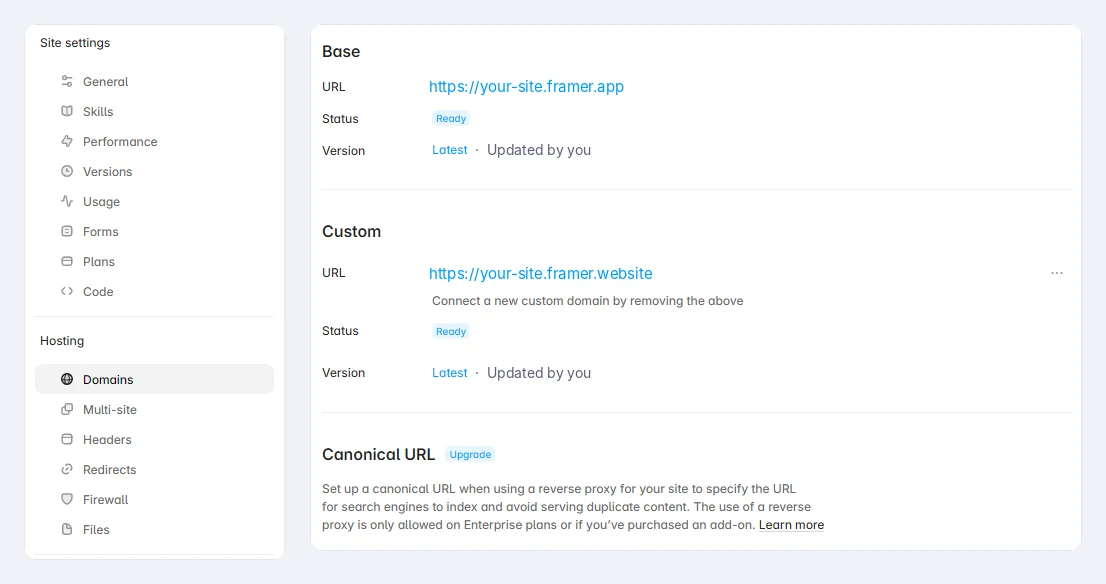
Every builder gives you a few DNS records to add at your registrar. As an example, Framer asks for:
- Two A records on your main domain (@): 31.43.160.6 and 31.43.161.6
- A CNAME record for www: sites.framer.app
Add them in your registrar’s DNS settings and remove any other A or AAAA records on the domain, which can get in the way. Framer says the change can take up to 48 hours to work everywhere, though it’s usually much quicker.
If you haven’t built the portfolio yet, my guide to building a portfolio in Framer in a weekend includes the domain step. For what each builder costs once a domain is connected, see Framer pricing explained and Webflow pricing explained. And if you’re not sure you need your own site at all, read Behance vs your own portfolio site.
The short version
- Name: your own name, on a .com.
- If it’s taken: add “design” or “studio”, or a middle initial. No hyphens or numbers.
- Ending: .com first. Budget for the renewal price if you pick .design or .studio.
- Where: a registrar with the same price every year, such as Cloudflare Registrar or Porkbun.
- After buying: auto-renew on, email verified, privacy on.
Questions people ask
Should my portfolio domain be my name or a brand name?
Your name, for most designers. It stays right if you change specialty, move jobs or go freelance, and people searching for you will find it. A studio name makes sense only if you're building an agency that will have more people than you.
Is .design or .studio bad for SEO?
Google doesn't rank a page lower because of its ending. The real problems are price and memory: .design renews at $46.86 a year at Porkbun, and some people will type .com out of habit. If you use one, try to own the .com as well.
How much should a domain cost?
About $10 to $12 a year for a .com at a registrar that doesn't mark up renewals. Cloudflare Registrar charges $10.46 now and $11.17 from 1 November 2026, and Porkbun lists $11.08. If a renewal is $18 or more for a .com, you're paying a markup.
Can I use the free domain that comes with my website builder?
You can, but check what it renews at. Squarespace says its free domain renews for $20 after the first year, and Framer's free domain renews at Hover's standard rate, which its page doesn't list. Buying the domain yourself keeps it separate from your builder, so you can switch builders without moving the domain.
How long does it take to connect a domain?
Adding the records takes a few minutes. Framer says the change can take up to 48 hours to work everywhere, though it's usually much faster.
My name.com is taken. What now?
Add a short word (yournamedesign.com or yournamestudio.com), add a middle initial, or use a different ending. Avoid hyphens and numbers, because they're hard to say out loud and easy to get wrong.
Written by Talha Riaz
UI/UX, brand and packaging designer
Designer with 8+ years across UI/UX, brand identity and packaging, and 76 projects for clients in the US, UK and Middle East. I have used Adobe Portfolio for years, built a small portfolio in Framer, and helped a developer on Webflow client sites.
More about meHow I test toolsReport an outdated price or error